Your Trusted Boiler Feed Pump Supplier
Boiler Feed Pumps
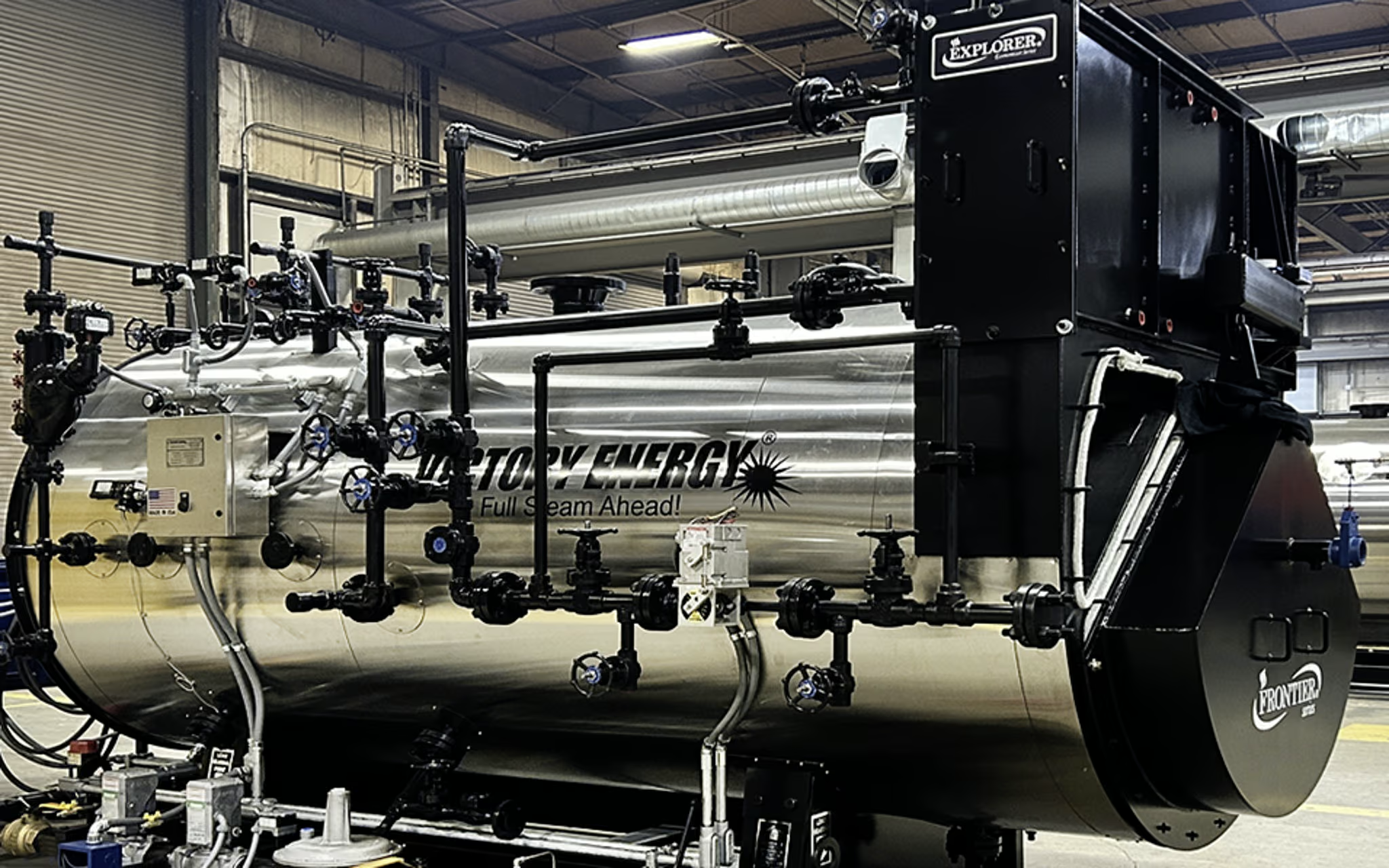
Tri-Tech Sales is a commercial and industrial boiler feed pump supplier serving steam plants throughout the United States. We supply regenerative turbine and centrifugal boiler feed pumps, condensate return units, and complete boiler room pumping equipment matched to your application. From individual pump replacements to complete duplex feed systems, our team helps you select the right equipment and get a quote quickly.
With experience serving healthcare, manufacturing, food processing, education, municipal facilities, and other demanding industries, we understand that the right boiler feed pump depends on more than simply matching a pump to boiler horsepower. We evaluate the actual system conditions to recommend equipment that will perform reliably in your application.







Boiler Feed Pump Sales and Equipment We Supply
Tri-Tech Sales supplies pumps through our partnership with GPM, a USA-based pump manufacturer and distributor. For boiler feed and condensate return applications, this includes MTH regenerative turbine pumps designed for low-flow, high-pressure service, with standard models rated up to 1,000 psi. We also offer compact centrifugal designs and sealless canned-motor pumps for specialty applications. Because Tri-Tech represents the broader GPM product line, we can also supply many of the other pumps found throughout a steam plant. Our equipment offerings include:
- Regenerative turbine boiler feed pumps
- Multistage and compact centrifugal boiler feed pumps
- Condensate return pumps and packaged return units
- Duplex boiler feed systems with receivers, controls, and valves
- Deaerator and surge tank pump packages
- Sealless canned-motor pumps for specialty service
- Boiler room sump, pit, and dewatering pumps
- Chemical metering pumps for boiler water treatment
- Fuel oil pumps for dual-fuel and oil-fired burner systems
- Mechanical seals and repair parts
- Pump replacement and retrofit packages
)
How A Boiler Feed Pump Works
A boiler feed pump plays a critical role in delivering hot feedwater to the boiler at a pressure sufficient to overcome the boiler's operating pressure and system losses. The feedwater, often near its boiling point, requires the pump to generate sufficient discharge pressure while handling water with minimal margin before it flashes into steam.
Proper boiler feedwater pump selection is essential to avoid cavitation, which occurs when vapor bubbles form and collapse inside the pump due to inadequate net positive suction head (NPSH). Cavitation can damage impellers, seals, and other components, compromising reliable feedwater delivery.
In deaerator applications, where feedwater is at saturation temperature, the vessel pressure and water vapor pressure effectively cancel out when calculating NPSH available. This means the available suction head is largely determined by the static elevation between the deaerator water level and the pump inlet, less friction losses in the suction piping. Selecting suitable boiler feedwater pumps that generate sufficient pressure to overcome steam pressure developed by the boiler is essential for efficient power generation and safe operation.
)
Pump Selection
Regenerative Turbine vs. Multistage Centrifugal Boiler Feed Pumps
Regenerative turbine pumps are well suited for low-flow, high-pressure boiler feed applications, making them a common choice for on/off feed service on firetube and smaller watertube boilers. Multistage centrifugal pumps are typically used for larger boiler plants and continuous-feed systems, where they provide higher capacities and operate with modulating feedwater valves. Multistage pumps can also pair well with variable frequency drives, while continuous-feed applications require appropriate minimum flow device protection to prevent the pump from operating near shutoff and overheating. Both pump types must be properly selected and constructed for the boiler's flow, pressure, temperature, operating conditions, and suction conditions to ensure optimal performance and avoid failure.
Boiler Room Sump, Pit, and Dewatering Pumps
Not every pump in the boiler room feeds the boiler. Blowdown pits, condensate pits, and boiler room sumps can collect hot, dirty water that can quickly wear out light-duty sump pumps.
Through GPM, Tri-Tech Sales can supply GPM-Eliminator heavy-duty submersible dewatering and slurry pumps designed for abrasive, solids-laden service. Properly selected pit and sump pumps help provide reliable drainage in demanding boiler room environments.
FAST, RESPONSIVE EQUIPMENT QUOTES
6 Locations: Council Bluffs, IA · Sioux City, IA · Lincoln, NE · Gibbon, NE · Rapid City, SD · Denver, CO
Phone: 800-874-9920
Email: support@tritechsales.com

One Partnership for the Whole Pump Room
Boiler feed pumps may be the most critical pumps in the boiler room, but a steam plant relies on many other pumps to keep the system operating. Because Tri-Tech Sales represents the full GPM product line, one source can cover a wide range of pumping applications:
- Multistage centrifugal and HVAC duty — Ebara stainless-steel end-suction, multistage, and HVAC pumps
- Chemical metering — Iwaki metering and air-operated diaphragm pumps for boiler water treatment chemical feed
- Fuel oil supply — Northern Pump high-pressure rotary gear pumps for dual-fuel and oil-fired burner systems
- Process and specialty duty — Flowserve industrial process pumps and mechanical seals; Sundyne high-pressure and integrally geared pumps
- Self-priming and utility service — Gorman-Rupp self-priming centrifugal pumps
- Sumps, pits, and dewatering — GPM-Eliminator heavy-duty submersibles and Tsurumi submersible pumps
- Motors and drives — TEFC and vertical motors, variable frequency drives, soft starters, and control panels
)
Why Choose Tri-Tech Sales?
- More than 25 years of boiler room experience
- Equipment recommendations backed by real installation and service knowledge
- Pumps selected for boiler pressure, evaporation rate, feedwater temperature, and suction conditions
- Responsive budgetary and formal equipment quotes
- Submittal support, including cut sheets and dimensional drawings
- Specification and application review
- 20,000+ parts stocked in house
- Local support from six offices across Iowa, Nebraska, South Dakota, and Colorado
- Equipment options for commercial and industrial steam plants
)
Frequently Asked Questions About Boiler Feed Pumps
What does a boiler feed pump do?
A boiler feed pump delivers feedwater to the boiler at a pressure high enough to overcome the boiler's operating pressure and the losses in the feedwater piping system. The pump replaces the water that leaves the boiler as steam and works with the boiler's level controls to maintain the proper water level.
Depending on the application, the pump may start and stop based on an on/off level control or operate continuously with a modulating feedwater valve.
What is the difference between a boiler feed pump and a condensate pump?
A condensate pump collects returned condensate from the steam system and moves it at relatively low pressure back to a receiver, feedwater tank, or deaerator.
A boiler feed pump takes water from the feedwater tank or deaerator and delivers it into the boiler at high pressure.
Although both pumps handle hot water in the boiler room, their pressure requirements are significantly different. A condensate-duty pump is not designed to perform the high-pressure service required for boiler feedwater.
What type of pump is used for boiler feed?
Regenerative turbine pumps and multistage centrifugal pumps are two of the most common boiler feed pump designs. Regenerative turbine pumps are often used for on/off feed service on firetube and smaller watertube boilers because they can produce high pressure at relatively low flow rates while maintaining a compact footprint. Multistage centrifugal pumps are generally better suited to larger plants and continuous-feed applications where higher flow rates and modulating control are required.
How is a boiler feed pump sized?
For power boilers built to ASME Section I, each feed source must be capable of delivering water at a pressure 3% higher than the highest safety valve setting on the boiler. Pump discharge pressure therefore needs to account for the safety valve setting, the required margin, and the piping, valve, and elevation losses between the pump and boiler.
Should I have a standby boiler feed pump?
For facilities where reliable steam production is critical, a standby boiler feed pump provides an important layer of redundancy.
ASME Section I requirements vary by boiler type and application. For boilers with more than 500 square feet of water-heating surface, two means of feeding water are required, while certain gas- and oil-fired boilers with automatic low-water fuel cutoffs may be permitted to use a single feed source.
How long does it take to get a new boiler feed pump?
Lead times vary depending on the manufacturer, pump type, construction materials, motor horsepower (hp), and current equipment availability. Standard boiler feed water pumps and commonly stocked configurations may ship quickly, while custom-engineered pumps and duplex packaged systems with specific dimensions and weight requirements can require additional time. Factors such as the pump's stage count, rpm, and energy efficiency also influence delivery schedules. Planning ahead and ordering the right boiler feed pump item ensures timely delivery and smooth installation, helping avoid potential problems that result from delays.
Contact Us
Locations: Nebraska, Iowa, South Dakota, Colorado.
24/7 Phone: 800-874-9920
Email: support@tritechsales.com
Office Hours: Monday – Friday: 7:00am – 4:00pm